
Virtual Accounts Guide
Overview
Virtual accounts represent a holding account that is maintained “above-the-core” (outside your traditional core banking platform). Each virtual account holds a customer deposit type, has a unique account number, and is associated with a customer. Each virtual account is linked to a settlement account on the bank’s core system (which retains a routing number). Virtual accounts can send and receive money on behalf of the settlement account, where the funds are ultimately held.
Businesses often create multiple virtual accounts—each designated to a specific client, transaction, entity, or other business reason—to segment funds. For banks, virtual accounts help lower operational costs by avoiding the need to put all customer accounts on the legacy core platform. Banks offer this model to fintechs and brands as an advantage, while passing through FDIC insurance for the virtual accounts.
FBO Accounts (or Omnibus)
An FBO (For Benefit Of) account allows a fintech or brand to manage funds on behalf of one or more of their users. It organizes a large volume of virtual accounts under a single settlement account at the bank. Our Virtual Ledger system tracks all funding and provides full transparency into each virtual account and money movement transaction.
An Omnibus (or cash management) account uses a similar model: transactions across two or more parties are combined under one holding or settlement account. This enables the bank to manage a customer’s accounts as a single entity—leveraging cash management efficiencies, lower operating costs, and anonymity.
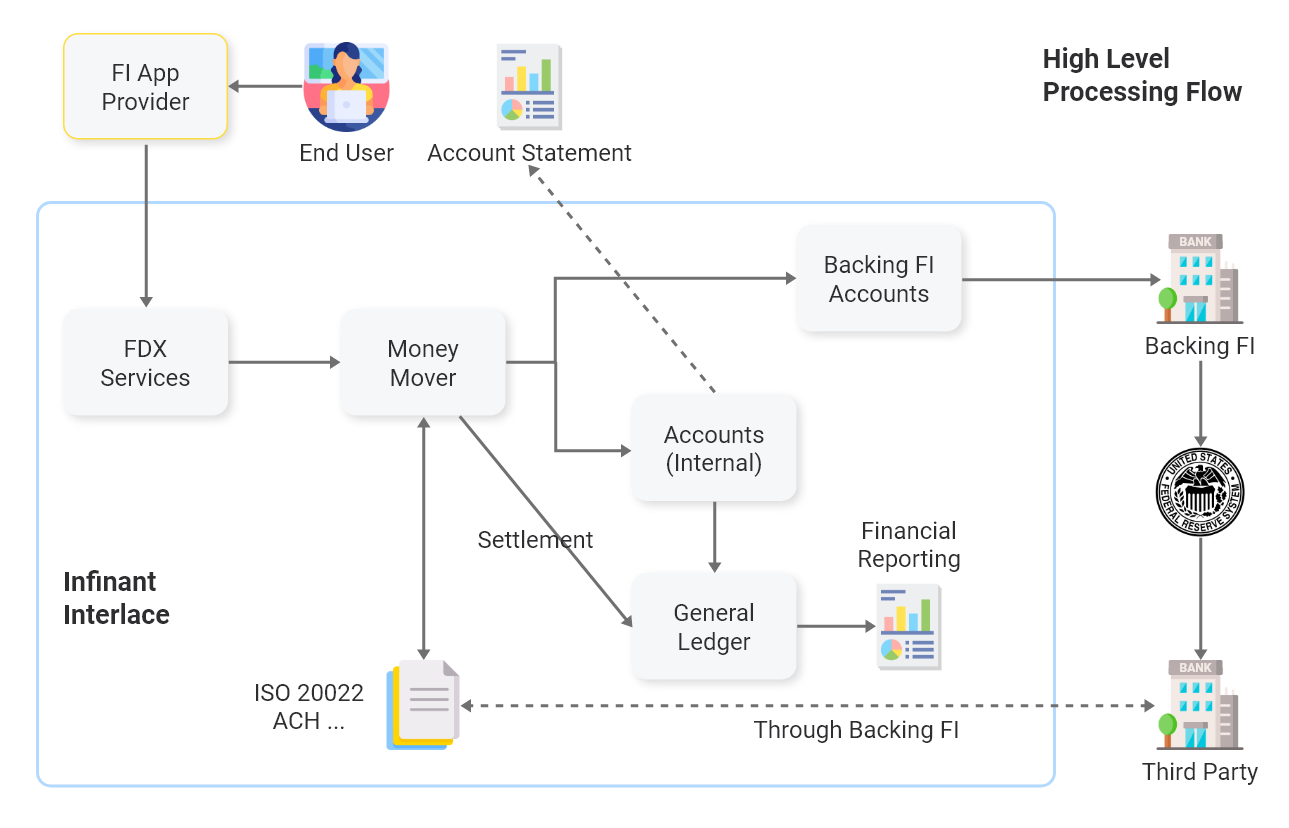
Creating Virtual Accounts
On the Interlace platform, virtual accounts are created via our Customer and Account Content Pack APIs. These APIs provide an orchestrated flow:
- Gather relevant customer information.
- Verify and authenticate the customer through KYC procedures.
- Create the customer record.
- Create the specific account-type on our system.
Access to customer and account creation is secured and only available through authenticated Interlace platform APIs. Once created, virtual accounts can be viewed and serviced through the Interlace Management Console.
Virtual Account Funding and Money Movement
Money can move into and out of a virtual account through various methods—external transfers, internal transfers for existing customers, ACH, wires, bill pay, etc. All transactions are associated with the customer’s virtual account and are housed within the Interlace Virtual Ledger.
Virtual Ledger
Every money movement (deposit, payment, transfer) for a virtual account is recorded in our Interlace Virtual Ledger. The ledger is:
- Accountable & Immutable: Cryptographically verifiable log of all transactions.
- Event-Driven: Real-time data streaming ensures a complete history.
- Virtual Accounting System: Verifies customer and account funds, reserves funds (e.g., for ACH processing).
- Output Files: Supports BAI2, CAMT, and other settlement formats for bank reconciliation.
Customer Servicing
Customers can access and view:
- Their profile record.
- List of virtual accounts.
- Transaction history.
- KYC results and compliance information via the platform UI.
Statements
All transactional activity for a virtual account is available as a bank statement. Statements can be:
- Retrieved programmatically via the Content Pack API.
- Viewed in the Interlace Management Console.
Settlement
Virtual accounts are typically backed by an FBO account at a partner bank, where aggregated funds are stored. A reserve account acts as a buffer for disputes, fraud, returns, etc. The Interlace Virtual Ledger:
- Produces settlement and activity reports for daily fund settlement.
- Generates audit and regulatory reports.
- Offers scheduled and on-demand settlement files via the Management Console.
Webhooks
To notify applications of customer or account activity, the Interlace platform provides webhook support. See the Webhooks section for a full list of events you can subscribe to.
Updated 2 months ago