
Money Movement

This section describes the use cases related to the movement of money to and from Interlace accounts.
On the interlace platform, accounts can be associated with bank customers, bank partner’s customers, or with program operating accounts. In all cases, accounts allow the account owner to move money and make payments in various ways.
The Interlace platform supports various account types with the ability to apply account entitlements and define account parameters that configure the types of money movement enabled for each account type.
Interlace provides automated settlement operations to streamline your partner banking and embedded banking programs across multiple providers to reduce manual reconciliation, to avoid co-mingling of funds, and improve your operating efficiency. Interlace performs auto-reconciliation of money movement in real-time to handle funds flow from end-user accounts to the program’s operating accounts, to the bank’s operating and general ledger accounts. This includes the ability to assess and track end-user and program level fees.
Based on our bank compliance requirements, the Interlace platform monitors fraud in real-time along with support for bank and partner AML processes.
Immutable Ledger
Interlace accounts can be thought of as a virtual account system which handles the maintenance of customers and their associated accounts. All financial transactions associated with the Interlace accounts are settled in real-time to the Interlace Ledger – a key differentiator to the Interlace Platform. This separate and distinct ledger from the virtual account system safeguards transactions so they cannot be altered, tampered with, or deleted, ensuring a permanent and trustworthy record of all transactions. The double-entry ledger provides full transparency and auditability of all financial transactions to ensure regulatory compliance and data access for financial reporting. In addition, this allows Interlace to properly settle financial transactions to the bank’s general ledger and bank operating accounts.
Interlace supports various payment capabilities as outlined below.
Internal Funds Transfer
An internal funds transfer refers to the electronic transfer of funds between two accounts that reside within the same financial institution. In this case, the verified bank customer can easily transfer funds as the account ownership and account status are known.

Internal transfers can be set up as a one-time transfer, scheduled transfer, or recurring transfer. In addition, you can inquire to get a list of all pending transfers or update a pending transfer.
To perform a transfer, please refer to the Money Movement / Transfers section in our API reference.
External Funds Transfer
An external funds transfer often referred to as an ACH transfer, is the electronic transfer of funds between two accounts that reside within different financial institutions. In this case, funds can be transferred from the external bank account to another bank account of the same customer, to another person’s account such as friends or family, or to pay bills.
To securely transfer funds between U.S. financial institutions, the funds pass through the Automated Clearing House secure network. Your bank submits a request to the ACH network to transfer funds between the accounts you’ve specified. ACH then uses its own secure channels to complete the transaction

The platform also provides the capability to verify the ownership of the external account prior to the ACH request being initiated. To perform an external funds transfer, please refer to the Money Movement / ACH section in our API reference.
Real-Time Payments

Real-Time Payments (RTP) is the fastest method of moving money. Real-Time Payments are implemented by two services Federal Reserve’s FedNow® and The Clearing House’s RTP®, both are instant payment methods.
The Interlace APIs support the ISO 20022 standard for message sending and receiving, making our solution compatible with real-time payment rails. Infinant’s solution processes payments from our accessible API, a payment instruction file (PIF), or a prefabricated (prefab) user experience that either the bank or Infinant can supply.
To test our RTP APIs in a sandbox environment, please refer to the RTP section in our API reference.
Primary Use Cases
| Customer | Use Case | Description |
|---|---|---|
| Commercial | Credit Transfer | Commercial clients can send a one-time payment to a vendor to take advantage of dynamic discounting incentives. |
| Commercial | Accounts Payable | Send your payment instruction files to Infinant's payment facilities, configure supplier rules, and funding sources based on transfer amounts, supplier type, and other criteria. |
| Commercial | Request for Payment | If you commercial clients have an invoice being sent out to a customer, provide them with a fast and easy payment option through our Request for Payment feature. |
| Consume | Credit Transfer | Engage consumers with a P2P option to send money in real-time to friends, family, and small businesses. |
Wires
Wires are a type of monetary transfer with the primary difference is that the funds typically leave the customer’s account immediately.
The customer will need to provide the payee bank name, routing number, and payee account number to authorize a payee to initiate the wire.
To review the Wire services, please refer to the Money Movement / Wire section in our API reference.

Mobile Check Deposit
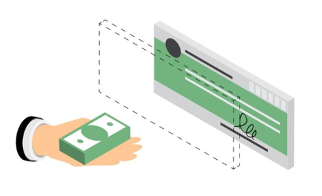
Mobile Check Deposit or Remote Deposit Capture (RDC) refers to the online process of the customer taking a picture of a paper check and processing the deposit into their bank account from their online banking application. This capability is typically handled through the customer’s mobile phone and once the check image is sent to the financial institution, the deposit process is similar to the deposit process of paper checks.
The Interlace APIs support this workflow through our partner. To implement RDC, the digital application is required to embed the third-party component to properly capture the check image for processing. Infinant provides support for use of the third-party component and implementing this feature.
To test RDC, please refer to the Money Movement section in our API reference.
Updated 2 months ago
What’s Next
Take a deep dive into our Money Movement: